How Many Cups in a Liter? US, Metric and Imperial
 By Shihab Mia June 23, 2026 8 min read

Quick answer
There are about 4.227 US customary cups in 1 liter (because 1 US cup is 236.588 ml). With a metric cup of 250 ml there are exactly 4 cups in a liter. A US legal cup of 240 ml gives about 4.167 cups, and an imperial cup of 284 ml gives about 3.52 cups.
The cup is not a single fixed size, which is why this question has more than one right answer. A liter is a precise metric unit, but the word "cup" means different volumes depending on whether you are using a US measuring cup, a metric cup, a US legal cup printed on nutrition labels, or a British imperial cup. Below you will find every version, a clear chart, the simple formula, and the mistakes that trip people up.
The exact numbers for each cup
A liter equals 1000 milliliters, so the number of cups in a liter is just 1000 divided by the size of one cup. Here is what that gives for each common cup definition:
- US customary cup (236.588 ml): about 4.227 cups per liter (1000 divided by 236.588)
- Metric cup (250 ml): exactly 4 cups per liter (1000 divided by 250)
- US legal cup (240 ml): about 4.167 cups per liter (1000 divided by 240)
- Imperial cup (284 ml): about 3.52 cups per liter (1000 divided by 284.131)
The US customary cup of 236.588 ml is the one in most American recipes and measuring sets, so 4.227 cups per liter is the figure you usually want. The metric cup of 250 ml, used in Australia, New Zealand and much of Europe, is the friendliest because it divides a liter into a clean 4. If you also work in fluid ounces, see how many ounces are in a cup to connect cups back to ounces.
Liter to cups conversion chart
Common liter amounts converted to cups for US customary, metric, and imperial cups.
| Liters | US cups (236.6 ml) | Metric cups (250 ml) | Imperial cups (284 ml) |
|---|---|---|---|
| 0.25 L | 1.06 cups | 1 cup | 0.88 cups |
| 0.5 L | 2.11 cups | 2 cups | 1.76 cups |
| 1 L | 4.23 cups | 4 cups | 3.52 cups |
| 1.5 L | 6.34 cups | 6 cups | 5.28 cups |
| 2 L | 8.45 cups | 8 cups | 7.04 cups |
| 3 L | 12.68 cups | 12 cups | 10.56 cups |
| 5 L | 21.13 cups | 20 cups | 17.60 cups |
If you mostly cook in US units, a liter sits between 4 and 4.25 cups, which is just over a quart. For the related US breakdowns, see how many cups are in a quart and how many liters are in a gallon, then apply the cup factor to whichever amount you have.
The formula for liters to cups
Converting is a single division or multiplication. Pick the right cup size, then use the matching constant:
- Liters to US cups: cups = liters multiplied by 4.22675
- Liters to metric cups: cups = liters multiplied by 4 (exact)
- US cups to liters: liters = cups divided by 4.22675 (or multiply by 0.236588)
- Metric cups to liters: liters = cups divided by 4
Worked example: a 1.5 liter bottle in US cups
Suppose a recipe lists 1.5 liters of stock and your measuring set uses US cups. Work through it step by step:
- Confirm the cup type. A standard US measuring cup is 236.588 ml, so use the factor 4.22675.
- Write the formula: cups = liters multiplied by 4.22675.
- Plug in the value: cups = 1.5 multiplied by 4.22675.
- Do the math: 1.5 multiplied by 4.22675 equals 6.34012.
- Round sensibly: you need about 6.3 US cups, or roughly 6 and one third cups.
To reverse it, divide by the same factor. If you measured 8 US cups, then 8 divided by 4.22675 is about 1.89 liters. The cooking converter below does this instantly for any unit, but knowing the factor lets you sanity-check the result.
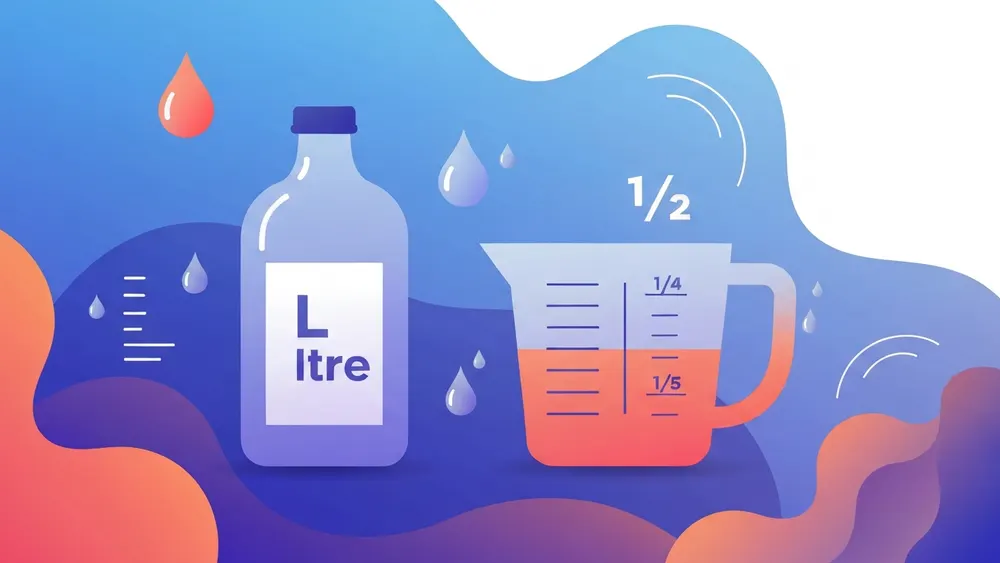
US cup vs metric cup vs imperial cup
Good to know
The metric cup (250 ml) is about 6 percent larger than the US customary cup (236.6 ml). That small gap is exactly why a liter splits into a clean 4 metric cups but an awkward 4.227 US cups. For most home cooking the difference is too small to ruin a dish, but it adds up over large batches.
The US customary cup is the legacy measure baked into American cookbooks and measuring sets. The US legal cup of 240 ml is a slightly rounder figure defined for nutrition labels and serving sizes, which is why a "cup" on a food package is not identical to the cup in your drawer. The metric cup of 250 ml is the standard across Australia, New Zealand, Canada and much of Europe, and the imperial cup of 284 ml is an older British unit you will mostly meet in vintage recipes.
When a recipe does not say which cup it means, look at where it was published. American sources almost always mean the 236.6 ml customary cup, while recipes from Australia, the UK or Europe usually mean the 250 ml metric cup. When in doubt, convert everything to liters or milliliters first, since the liter is the same everywhere and gives you a neutral common ground.
Common mistakes to avoid
Almost every liter to cup error comes from one of these slip-ups:
- Assuming a liter equals exactly 4 cups everywhere. That is only true for the 250 ml metric cup. With US cups a liter is about 4.227, so rounding to 4 drops more than a fifth of a cup per liter.
- Mixing up the cup types. A US cup, a metric cup, and an imperial cup are all different sizes. Using the wrong one can shift your answer by up to 20 percent on imperial figures.
- Confusing milliliters with liters. There are 1000 milliliters in a liter, so a US cup is 236.6 ml, not 23.66 ml. Dropping or adding a zero is a classic mistake.
- Measuring dry and liquid the same way. Cups measure volume, so a cup of flour and a cup of water fill the same space but weigh very differently. If you need weight, convert with a grams to cups converter instead.
- Rounding too early. If you round 4.22675 down to 4 at the start of a multi-step recipe, the error grows fast over several liters. Keep at least 4.23 for everyday work.
If you convert kitchen units often, the same care applies across the board. Browse related guides like how many cups are in a pint for the smaller US link, and how many grams are in a cup when you need to switch between volume and weight for a specific ingredient.
Liters and cups in everyday situations
The conversion shows up far beyond recipes. A standard 2 liter soda bottle holds about 8.45 US cups, which is why it pours roughly eight servings. The single-use water bottles most people carry are 500 ml, so two of them make about 4.23 US cups, almost exactly a full liter. If a fitness plan tells you to drink 2 liters of water a day, that is close to 8.5 US cups, which lines up nicely with the familiar "eight glasses" guideline once you account for cup size.
Coffee and tea makers are another common case. Many drip machines mark their carafe in 5 ounce "cups" rather than real measuring cups, so a "12 cup" pot is closer to 1.8 liters than to 12 US measuring cups. Whenever a number looks off, fall back to milliliters, since 1 liter is always 1000 ml no matter what device or country you are in. That neutral base is the safest way to compare two cup figures that were defined differently.
Fast mental math
To turn liters into US cups in your head, multiply by 4 and add about 5 percent. So 3 liters is roughly 12 cups plus a little, which rounds to 12.7 cups. For metric cups just multiply by 4 with nothing extra. Going the other way, divide cups by 4 for a quick liter estimate that is close enough for most cooking.
How liters and cups relate to other units
It helps to see the cup sitting inside the wider family of volume units. One liter is just over one US quart (a quart is about 0.946 liters), and there are 4 US cups in a quart, which is part of why a liter lands near 4.227 cups. One liter also equals about 33.8 US fluid ounces, roughly 4.2 cups at 8 ounces each. Tablespoons scale the same way: with about 16 tablespoons per US cup, a liter holds close to 67.6 tablespoons.
- 1 liter is about 1.057 US quarts and about 0.264 US gallons
- 1 liter is about 33.81 US fluid ounces
- 1 liter is 1000 milliliters exactly, the cleanest base to convert from
- 1 US cup is 8 US fluid ounces, 16 tablespoons, or 236.588 ml
Because every one of these units traces back to milliliters, you can always route a tricky conversion through ml and avoid guessing. For the broader picture across quarts, pints and gallons, see how many liters are in a gallon and how many cups are in a pint.
Convert any kitchen amount instantly
For liters, milliliters, US cups, metric cups, ounces, tablespoons and more in one place, use the converter below. Enter any amount and it handles the arithmetic, including the cup differences, so you never have to remember the exact factor.
🥄 Try the free tool Cooking Measurement Converter Free cooking converter for cups, tablespoons, teaspoons, fluid ounces, pints, quarts, ml and litres. Instant US customary kitchen measurement conversions.The bottom line: a liter holds about 4.227 US customary cups, exactly 4 metric cups, and about 3.52 imperial cups. Pick the right cup, multiply by the matching factor, and you will get a clean conversion every time.
Frequently asked questions
How many cups are in a liter?
There are about 4.227 US customary cups in 1 liter, since one US cup is 236.588 ml. With a metric cup of 250 ml there are exactly 4 cups per liter. Most American recipes use the US cup, so 4.227 cups, or roughly 4 and a quarter, is the figure you usually want.
Is a liter exactly 4 cups?
Only with the metric cup of 250 ml, which divides a liter into a clean 4 cups. With the US customary cup of 236.6 ml a liter is about 4.227 cups, and with the US legal cup of 240 ml it is about 4.167 cups. So 4 cups is exact only in metric countries.
How many US cups are in 2 liters?
Two liters hold about 8.45 US customary cups, found by multiplying 2 by 4.22675. In metric cups of 250 ml, 2 liters is exactly 8 cups. A common 2 liter soda bottle therefore holds a little more than 8 US cups, or about 67.6 US fluid ounces.
How many cups are in half a liter?
Half a liter, or 500 ml, is about 2.11 US customary cups. In metric cups of 250 ml it is exactly 2 cups, and in imperial cups of 284 ml it is about 1.76 cups. For most cooking you can treat half a liter as just over 2 US cups.
Why is a liter not a whole number of US cups?
Because the US customary cup of 236.588 ml does not divide evenly into 1000 ml. The liter and the US cup come from two different measuring systems, so the link is the constant 4.22675 rather than a round number. The metric cup was set at 250 ml specifically to make 4 cups per liter.
How do I convert liters to cups quickly?
Multiply the number of liters by about 4.23 to get US cups, or by exactly 4 to get metric cups. For a fast mental estimate, multiply by 4 and add a little. To go the other way, divide the number of cups by the same factor to get back to liters.
How many glasses of water is 1 liter?
If a glass is a standard 8 ounce US cup, then 1 liter is about 4.2 glasses, since a liter is roughly 33.8 fluid ounces. Many water glasses hold more than 8 ounces, so in practice 1 liter is often 3 to 4 large glasses. Two liters lands near the familiar eight glasses a day target.
How many imperial cups are in a liter?
There are about 3.52 imperial cups in 1 liter, because one British imperial cup is 284.131 ml and 1000 divided by 284.131 is about 3.52. The imperial cup is larger than both the US and metric cups, so a liter fills fewer of them. You will mostly meet this unit in older British recipes.