How Many Cups in a Quart? Cups, Pints and Gallons
 By Shihab Mia June 20, 2026 4 min read
Quick answer
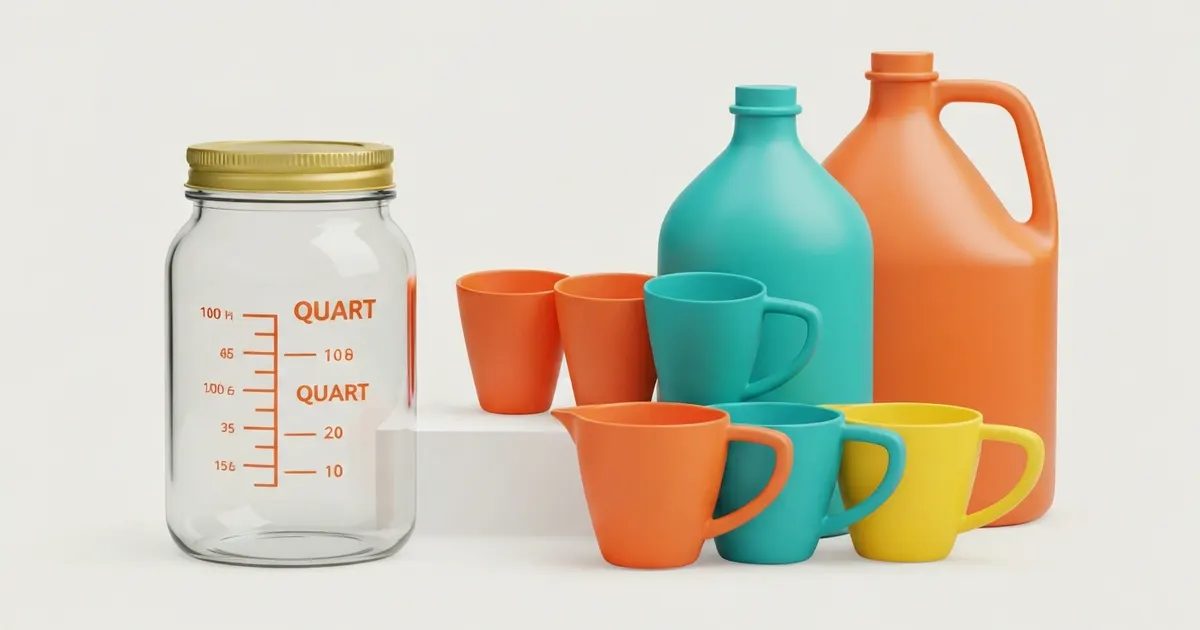
There are 4 cups in 1 US quart. A quart is also 2 pints, and 4 quarts make a gallon, which works out to 16 cups in a gallon.
If you are halfway through a recipe and the measuring lines on your jug suddenly switched from cups to quarts, you do not need to start over. The conversion is simple and worth memorizing: a quart holds exactly four cups. That single fact unlocks almost every other kitchen volume question, because the US system is built on a tidy chain of doublings.
Below you will find the full breakdown, where the number actually comes from, how US measures differ from UK and metric ones, and the small mistakes that trip people up most often.
Where the 4 cups in a quart comes from
US liquid volume doubles at almost every step, which makes the whole system easy to remember once you see it laid out. Two cups make a pint, two pints make a quart, and four quarts make a gallon. Walk that chain from cups to a quart and you pass through one doubling to reach a pint, then another to reach a quart. Two doublings of one cup gives you four cups, and that is your quart.
The word quart itself is a clue. It comes from the Latin quartus, meaning a fourth, because a quart is one quarter of a gallon. So the unit is literally named after its relationship to the gallon, and once you know a gallon is 16 cups, dividing by four gives you the 4 cups per quart instantly.
Cups, pints, quarts and gallons chart
| Unit | Cups | Pints | Quarts | Fluid ounces |
|---|---|---|---|---|
| 1 cup | 1 | 0.5 | 0.25 | 8 |
| 1 pint | 2 | 1 | 0.5 | 16 |
| 1 quart | 4 | 2 | 1 | 32 |
| 1 gallon | 16 | 8 | 4 | 128 |
A simple way to keep it straight: there are 2 cups in a pint, 2 pints in a quart, and 4 quarts in a gallon. Multiply along that chain and a gallon comes out to 16 cups. If you ever forget, just remember that each US quart is also 32 fluid ounces, and a cup is 8 fluid ounces, so 32 divided by 8 lands you right back at 4 cups.
US vs UK and metric quarts
Here is where many cooks get caught out. A quart is not the same size everywhere. The US liquid quart is about 0.946 litres, while the imperial quart still used in some UK and Commonwealth contexts is larger at roughly 1.137 litres. The imperial system also uses a 20 fluid ounce pint instead of the US 16 ounce pint, so the cup and ounce counts do not line up neatly between the two.
A few quick reference points to keep the systems separate:
- US liquid quart: 4 US cups, 2 US pints, 32 US fluid ounces, about 946 millilitres.
- Imperial quart: 40 imperial fluid ounces, 2 imperial pints, about 1,137 millilitres.
- Metric note: most modern recipes treat 1 cup as 240 millilitres and 1 quart as roughly 950 millilitres for cooking purposes.
- Australia uses a 250 millilitre metric cup, so an Australian quart equivalent does not map cleanly to the US 4 cup rule.
For everyday US recipes you can rely on 4 cups per quart with confidence. Just double check the source of a recipe if it was written in the UK or Australia, since the same word can mean a noticeably different amount of liquid.
Practical kitchen examples
The cups to quarts relationship shows up constantly once you start looking. A standard carton of broth or stock is one quart, which is exactly the 4 cups a soup recipe often calls for, so you can pour the whole carton in without measuring. A quart of buttermilk covers two batches of pancakes that each need 2 cups. And if a punch recipe asks for a gallon, you now know that is 16 cups or four full quart jugs.
Scaling recipes gets easier too. Need to triple a sauce that uses 1 cup of liquid? That is 3 cups, just under a quart. Cutting a gallon of iced tea in half? That is 2 quarts, or 8 cups. If you frequently move between cups, ounces and millilitres, our volume converter style references and the related ounces guides make the math automatic.
Worked example: scaling a soup to a quart
Say your favorite soup recipe makes 4 servings and calls for 2 cups of stock, 1 cup of cream and half a cup of wine, for a total of 3.5 cups of liquid. You want to make a full quart of soup so it fits one storage container. Since a quart is 4 cups, you only need to add half a cup more liquid. Scale every wet ingredient by the same factor, which here is 4 divided by 3.5, or about 1.14. The stock becomes about 2.3 cups, the cream about 1.14 cups, and the wine a little over half a cup. Round to the nearest tablespoon and your batch lands neatly at one quart.
This is the everyday value of knowing a quart is 4 cups. You can size a recipe to a container, a freezer bag or a thermos without a calculator. When the numbers get awkward, our cooking measurement converter friendly references and the volume converter handle the fractions for you.
Good to know
- Half a quart is 1 pint, which is 2 cups, so recipes that call for a pint and a half need 3 cups.
- A quart is 32 fluid ounces, and many sports bottles and water tumblers are sized at 32 ounces, so a full bottle is roughly one quart.
- Three quarts is 12 cups, and a quart and a half is 6 cups, two handy in-between amounts when scaling drinks.
- For dry baking ingredients, a quart by volume is still 4 cups, but the weight changes with the ingredient, so 4 cups of flour and 4 cups of sugar are both a quart yet weigh different amounts.
- If your only measure is a tablespoon, there are 64 tablespoons in a quart, since a cup is 16 tablespoons and a quart is 4 cups.
Common mistakes to avoid
Most quart conversion errors come from a handful of predictable mix-ups. Watch for these:
- Confusing dry and liquid quarts. A dry quart used for produce like berries is about 1.101 litres, larger than the liquid quart, so a dry pint basket is not the same as 2 liquid cups.
- Assuming all quarts are equal. As covered above, a US quart and an imperial quart differ by almost 200 millilitres.
- Mixing up cups in a pint versus cups in a quart. A pint is 2 cups and a quart is 4 cups, so doubling the wrong one is an easy slip.
- Trusting a coffee mug as a measuring cup. Many mugs hold 10 to 12 ounces, not the standard 8, which quietly throws off a quart measurement.
- Forgetting that nutrition or recipe cups are level, not heaped. Always level off liquids at eye level for an accurate quart.
If you keep those five in mind, your quart measurements will stay reliable. For the closely related question of how the smaller units stack up, see our guide on how many cups are in a pint.
Convert any amount instantly
For other volume conversions, including pints, gallons, millilitres and litres, use the converter below. Enter any value and it handles the chain of doublings for you so you never have to second guess a quart again.
🧪 Try the free tool Volume Converter Free volume converter for liters to gallons, ml to cups, tablespoons and fluid ounces. Type in any unit and the rest update instantly with exact US factors.Frequently asked questions
How many cups are in a quart?
There are 4 cups in 1 US liquid quart. A quart is also equal to 2 pints or 32 fluid ounces. This holds true for any liquid you are measuring, from water to broth to milk, as long as you are using standard US measuring cups that hold 8 fluid ounces each.
How many cups in a gallon?
There are 16 cups in 1 US gallon. The math is simple: a gallon contains 4 quarts, and each quart holds 4 cups, so 4 times 4 gives you 16 cups. A gallon also equals 8 pints or 128 fluid ounces if you prefer to work in those units instead.
How many pints in a quart?
There are 2 pints in 1 quart, and each pint is 2 cups, which is why a quart adds up to 4 cups total. Going the other direction, half a quart is one pint. This doubling pattern continues up to the gallon, where 8 pints make a full US gallon.
Is a US quart the same as a UK quart?
No. A US liquid quart is about 946 millilitres, while a UK imperial quart is larger at roughly 1,137 millilitres. The imperial pint and ounce are also bigger, so the cup counts do not match. If a recipe was written in the UK or Australia, check which quart it means before converting.
How many cups are in 2 quarts?
There are 8 cups in 2 quarts. Since one quart equals 4 cups, you simply multiply 4 by 2. Two quarts is also equal to 4 pints or half a gallon, a handy amount to remember when you are scaling soups, stocks or large batches of a drink up or down.
How many ounces are in a quart?
There are 32 fluid ounces in 1 US quart. That works out because a cup is 8 fluid ounces and a quart holds 4 cups, so 8 times 4 equals 32. A half quart, or pint, is 16 fluid ounces. Note that imperial quarts used in the UK are 40 imperial fluid ounces, which are slightly different in size.
How many quarts are in a cup?
One cup is one quarter of a quart, or 0.25 quarts, since 4 cups make a full quart. To convert cups to quarts, divide the number of cups by 4. So 6 cups is 1.5 quarts and 10 cups is 2.5 quarts. This is the reverse of the everyday quart to cups conversion most recipes ask for.
Is a quart bigger than a liter?
A US liquid quart is slightly smaller than a liter. One quart is about 0.946 liters, so a liter is roughly 1.06 quarts. For most cooking you can treat them as nearly equal, but for precise measurements like medicine or science the difference of about 54 milliliters per quart does matter.